Most vehicles on the road today feature automatic transmissions, providing drivers with reliable power delivery while requiring regular servicing by CARite of Yorkville service experts.
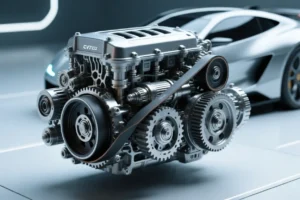
CVTs differ from traditional transmissions in that they use a belt and pulley system to seamlessly transition through an infinite number of effective gear ratios. But what exactly is a CVT?
Continuously Variable Transmission
CVT (Continuously Variable Transmission) is a type of automatic transmission that utilizes pulleys and belts or chains rather than gears to transfer power from engine to wheels. Commonly found in hybrid vehicles and smaller cars that need greater fuel efficiency, CVTs can keep engines revving at high rates during acceleration while also slowing it down more slowly for greater fuel economy.
CVTs offer several key advantages over multi-speed automatic transmissions, with their less abrupt shifts making it easier for drivers to settle into driving comfortably and ensuring engines remain within their optimal power band for optimal performance.
There are various kinds of CVTs, all using belts or chains to transfer power. What Is a CVT Transmission? – The most prevalent CVT type is the planetary CVT which consists of two pulleys connected by a belt with their sizes customizable to altering drive ratio; by changing their diameters you can switch from amplifying torque for acceleration purposes to decreasing it to reduce vehicle speed.
Cone CVTs operate by moving a wheel or belt up and down conical rollers. Their drive ratio can be varied by moving them along their axis of rotation to adjust as necessary; these CVTs can be found on motorcycles, side-by-sides, motor scooters, bicycles, and earthmoving equipment.
Finally, there’s the hydrostatic CVT. Although misnamed, this form of transmission relies not on rotary valves but instead uses hydraulic pumps to send oil under pressure to multiple hydraulic motors that create torque that turns wheels, while also keeping all oil within their respective sealed systems.
There is also the electric variable transmissions (EVT or eCVT), which combine an internal combustion engine’s output with an electric motor to enable its response to driving demand, such as those found in hybrid cars like Toyota Prius and Mitsubishi Outlander PHEV.
It’s Shiftless
People tend to prefer traditional automatic transmissions, but continuously variable transmissions (CVTs) may prove more efficient and provide a smoother ride. What Is a CVT Transmission? – If you’re shopping around Yorkville, NY for fuel-efficient small cars, a CVT may be your ideal solution.
CVT systems differ from traditional automatic transmissions in that they constantly adjust for optimal performance, eliminating hard shifting while making it easier for uphill or city traffic driving, improving gas mileage and offering seamless acceleration.
However, getting used to CVTs may require some adjustment. Many are programmed to “shift” with hiccups or fake engine noises to simulate traditional gearshifting, which may prove frustrating for drivers used to the familiar sensations found in traditional autos; moreover, some may perceive an eerie unsteadiness or power loss when using one of these vehicles.
Unsteadiness or power loss may also be caused by issues with the belt or pulley system, which requires regular maintenance to function optimally. Signs of failure include squealing or whining noises as well as delayed responses or sudden acceleration – keeping up with regular fluid changes and following manufacturer maintenance recommendations can help avoid these problems altogether.
CVTs may be more energy-efficient than traditional automatics, yet can still be less dependable due to not using the same mechanical components a traditional transmission does – which may cause overheating or premature wear problems.
Many enthusiasts have discovered that CVTs don’t last as long in their cars due to pushing their vehicles harder than non-enthusiasts – though this doesn’t indicate fault with the transmission; rather, it indicates different driving styles which strain any type of transmission system.
It’s More Expensive
CVTs are frequently found in hybrid vehicles and smaller cars where fuel efficiency is an objective, making them more costly than traditional auto transmissions but providing greater fuel economy by keeping engine RPM levels within an ideal RPM range. What Is a CVT Transmission? – When choosing between CVT and conventional automatic transmissions, consider your driving preferences and priorities when making this decision.
One drawback of CVTs is their inability to deliver the distinct shifting feeling preferred by some drivers, which can make transitioning between traditional and CVT transmissions feel awkward in sportier vehicles. Furthermore, some claim CVT systems are less durable than their conventional automatic counterparts; though this has improved greatly over the years. If purchasing a car equipped with CVT transmission it should be taken into consideration prior to purchase.
Maintenance costs associated with CVT transmissions tend to be higher due to their use of complex parts which are harder to repair than standard gears, plus many mechanics lack experience working on them, leading to higher labor expenses and labor charges.
If your car’s CVT needs repair, it is crucial that a certified technician be employed. A technician with appropriate licensing will be able to examine and replace worn out components like belts, pulleys or bearings as soon as they become necessary before reinstalling and testing to make sure everything works as it should.
CVTs may have seen great advancement in recent years, yet they’re still more costly to repair than traditional transmissions due to their complex network of pulleys and chains that require constant servicing. What Is a CVT Transmission? – Furthermore, many independent shops do not possess the equipment required to service CVTs effectively.
If you’re trying to reduce costs when it comes to CVT repairs, one way you might save is with a remanufactured transmission. These units go through extensive refurbishing to meet quality standards and come backed by warranties to lower repair expenses. Or consider purchasing from a reliable dealer and having it thoroughly inspected beforehand.
It’s More Complex (What Is a CVT Transmission?)
CVTs may have grown increasingly popular over time, yet their complexity remains significant compared to traditional automatic transmissions. A qualified auto technician could take 10 times longer servicing a CVT vehicle; as this technology requires precise engineering and advanced diagnostic tools. But these advances aim at increasing durability, fuel economy and driving dynamics.
CVTs are ideal for drivers who prioritize fuel economy and a refined driving experience free from shift shock. Their smooth acceleration makes them perfect for Santa Rosa’s surface streets and Highway 101 corridors where traffic congestion is an issue; plus they save hundreds of dollars in annual fuel costs while offering superior torque and horsepower to create a safer commute that’s also economical.
CVTs often struggle when faced with challenging terrain challenges from coastal highways to wine country hills, such as engine braking. Furthermore, CVTs often lack fixed gear ratios which prevent engine braking requiring heavier use of wheel brakes which overheat on long descents and could compromise driving confidence and performance. What Is a CVT Transmission? – Some newer models offer simulated gear steps or manual modes in an effort to help address these issues but cannot fully replicate true gear connections.
CVTs pose one major drawback compared to traditional automatic transmissions: increased power consumption. Their design uses a metal push belt squeezed between two variators to produce an infinite number of gear ratios, creating heat which must be dissipated efficiently using more sophisticated cooling systems and regular fluid changes; additionally, this increases acceleration energy requirements on steep grades or in traffic significantly.
Decisions between CVTs and automatic transmissions should ultimately depend on your personal priorities, driving habits, maintenance commitment, and long-term ownership plan. Both technologies offer distinct advantages and drawbacks; knowing these distinctions will allow for informed car shopping near Rohnert Park.